Comprehensive magnetic stripe card reader implementation featuring F2F encoding/decoding,
multi-track data processing, and professional-grade signal conditioning for reliable
financial and identification card reading.
Advanced magnetic data storage and reading technology
Magnetic Storage Principle
Magnetic stripe cards store data by modifying magnetism of tiny iron-based particles on a magnetic material band. Data is read by swiping against a magnetic reading head, detecting changes in magnetic flux as oriented domains pass the sensor.
F2F Encoding (Aiken BiPhase)
Utilizes frequency-shift encoding where magnetic domains create current spikes. Binary '1' comprises a single magnet (two units long), while '0' comprises two magnets (one unit each). This provides reliable data encoding and error detection.
Signal Processing Pipeline
Advanced analog and digital signal conditioning for reliable data extraction
Raw Magnetic Head Output
Magnetic Head
Magnetic reading head detects flux changes as card swipes, generating analog voltage variations corresponding to magnetic domain transitions.
Oscilloscope Capture
Signal Conditioning
Raw magnetic signals are amplified and conditioned to enhance signal-to-noise ratio and prepare for digital processing.
Peak Detection & Op-Amp Processing
Digital Processing
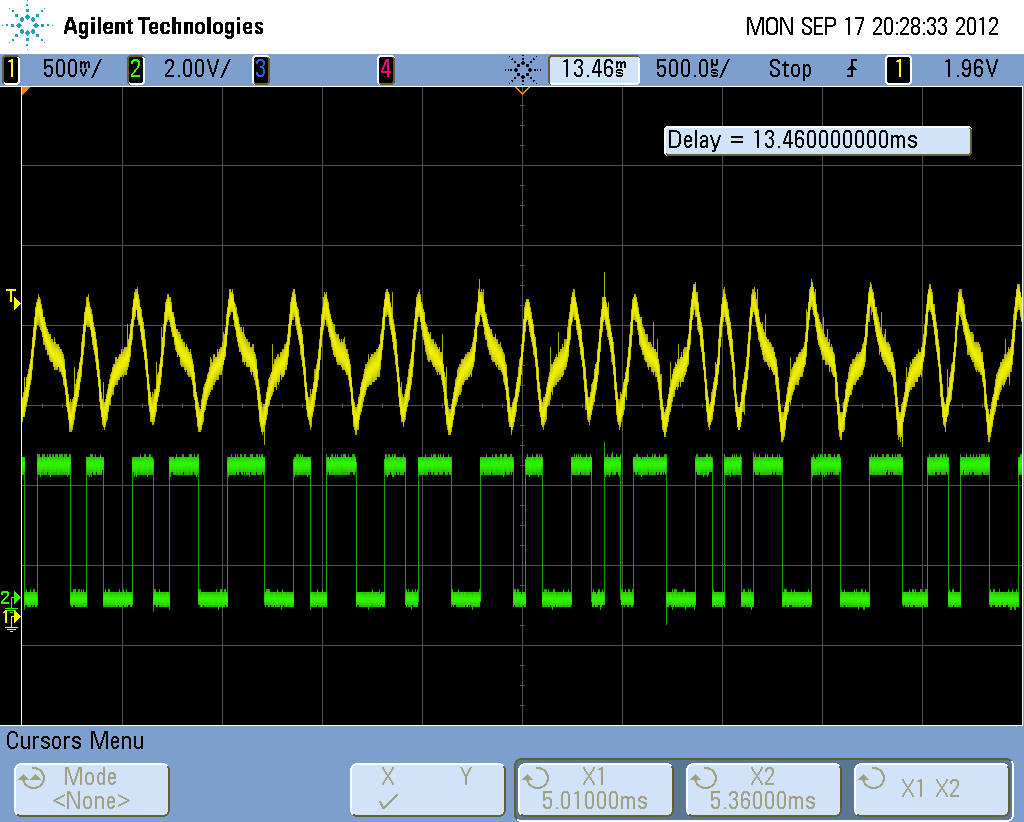
Op-amp circuits perform peak detection and signal shaping, converting analog variations to digital pulses for F2F decoding.
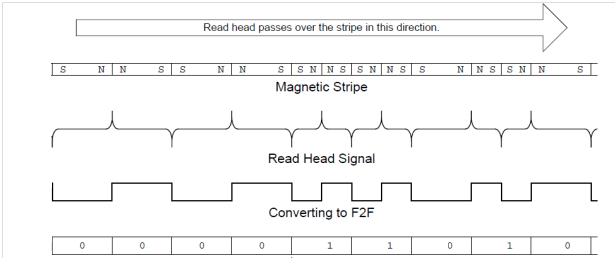
A magnetic stripe is composed of a string of magnetic domains, each oriented in a way such that opposite poles are adjacent.
In the areas where two magnets with like poles are touching, there is a concentration of magnetic flux which induces a current spike as they pass a magnetic read head.
Each bit of information has the same physical length on the strip. The presence or absence of an additional peak in the middle of the bit determines whether it is a one or a zero.
On a magnetic stripe, a one is comprised of a single magnet that is two units long and a zero is comprised of two magnets that are each one unit long.
This encoding scheme is known as F2F encoding (or Aiken BiPhase).
The signals
Data Format
Track 1 – IATA
The data standard for Track 1 was developed by the International Air Transportation Association (IATA) and contains alphanumeric information.
For example, on a credit card, this track typically contains the card holder’s name as embossed on the front of the card. The specification allows up to 79 characters.
Each character is 7 bits long, comprising a 6 bit character code and a parity bit.
The format
Control Characters:
SS = Start Sentinel %
FS = Field Separator ^ FC = Format Code
ES = End Sentinel ? LRC = Longitudinal Redundancy
The Track 1 data format includes the following items:
1. Approximately 62 leading clocking zeros.
2. The Start Sentinel "%" (SS).
3. Up to 76 alphanumeric characters.
4. The end sentinel "?"(ES).
5. The LRC (longitudinal redundancy check character).
6. Trailing clocking zeros (minimum of 62) to the end of the card.
Each data character is in a 7-bit (6 plus parity) alphanumeric format. The data is in the format
"parity, 32, 16, 8, 4, 2, 1". Parity is odd (an odd number of "one's" in each character).
The character is written "backwards" on the card starting with the least significant digit and
ending with the parity bit. The card data format is "1, 2, 4, 8, 16, 32, parity".
Example: Track1Information read on a Credit card.
%B0123456789101112^ABCDEF/PQRST^01020304050607080910?8
Track 2 – ABA
The data standard for Track 2 was developed by the American Bankers Association (ABA), and contains
numeric information only. On a credit card, this track typically contains the card holder's credit card number as embossed on the front of the card. The specification allows up to 40 digits. Each digit is 5 bits long, comprising a 4-bit BCD digit and a parity bit. .
The format
The Track 2 data format include the following items:
1. Leading clocking zeros: Approximately 22.
2. The Start Sentinel ";" (SS).
3. Up to 37 hexadecimal numeric characters.
4. The end sentinel "?"(ES).
5. The LRC (longitudinal redundancy check character).
6. Trailing clocking zeros: A minimum of 22 (track 2) to the end of the card.
Each data character is in a 5-bit (4 plus parity) numeric format. The data is in the format "parity,
8, 4, 2, 1. Parity is odd (an odd number of one's in each character).
Example: Track2 Information read on a Credit card.
;0123456789101112=01020304050607080910?:
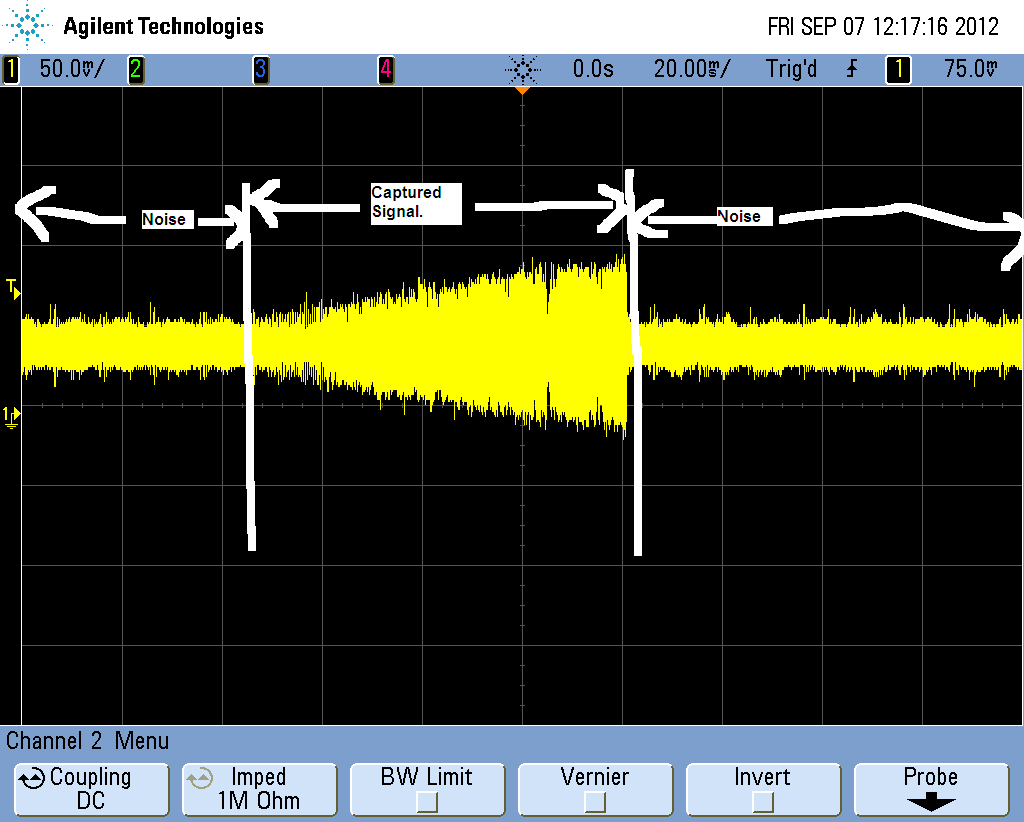
The output of magnetic read head
The output of Op-Amp and peak detection
Data Format Standards
Industry-standard track formats for comprehensive card data processing